
Color Scheme

Daniel Lacalle: UAE cuts off all trade...

UAE cuts off all trade and financial transactions with Iran. The Iranian terror regime is increasingly isolated. The largest country they import from has cut them off completely: ~30% of pre war imports and ~13% of pre war exports
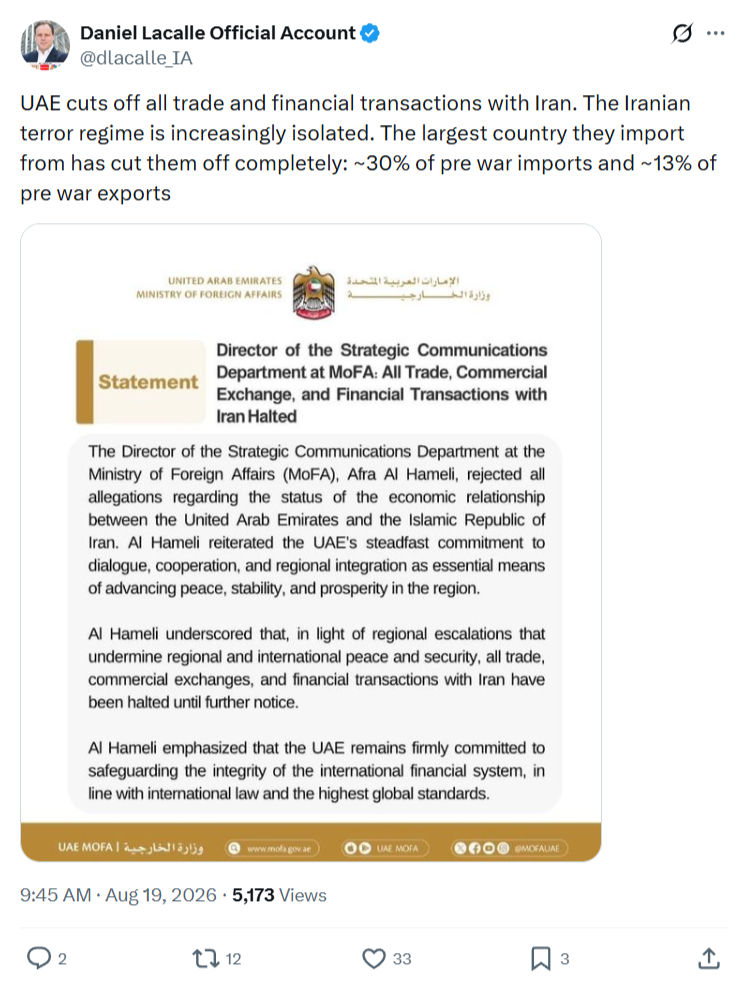
Daniel Lacalle: UAE cuts off all trade...
https://x.com/dlacalle_IA/status/2089967050613514413

Daniel Lacalle: Iran's "resistance" strategy...

Iran's "resistance" strategy has backfired spectacularly. The regime bet its entire strategy on threatening neighbors, funding terror proxies, and holding the world hostage over the Strait of Hormuz. That bet just collapsed. The regime only remains due to a system of terror and repression, not public support. The military power behind the threat has proven far weaker than advertised, incapable of even closing Hormuz to everyone except itself. The real lesson: Iran just exposed its own greatest vulnerability. ~80% of its exports and roughly 25% of its GDP flow through that strait. By trying to weaponize it, Tehran didn't scare the world. It just handed everyone a map of its biggest weakness. Iran has done more damage to its own economy than any sanctions regime ever could, while proving to global buyers that diversified, non-Iran energy routes are the safer bet long-term. Weakness disguised as leverage is still weakness.

Daniel Lacalle: Some are blaming Trump for Spain’s...

Some are blaming Trump for Spain’s migrant crisis, citing U.S. recognition of Morocco’s sovereignty over Western Sahara as a trigger. But Spain's Socialist PM already shifted his position on the Sahara months ago, without parliamentary approval. Sanchez's reckless pull-factor pro-migration policies, mass regularizations, and subsidies are to blame... and 22 EU nations agree. Blaming others does not change the facts.

Daniel Lacalle: Trump understood Iran would eventually breach the MOU...

Trump understood Iran would eventually breach the MOU. ✅ That’s why the deal was fully conditional: ✅ He bought time for Iranian crude to pile up at sea due to lack of buyers. ✅ He gave Iraq, Saudi Arabia, the UAE, and Oman time to deepen alternatives to Hormuz and secure supply. ✅ He strengthened U.S. domestic energy security. ✅ He waited for OPEC+ output increases to make Iran weaker and Hormuz less central. The US never trusted or gave strength to Iran. It was a strategic move to solidify alternatives and Gulf nation options. Many will not recognize it, but it is a solid strategy.

Daniel Lacalle: Full statement: "Following intensive talks, we are...

Full statement: "Following intensive talks, we are pleased to announce that the Peace Deal between the United States of America and Islamic Republic of Iran has been REACHED. Both sides have declared the immediate and permanent termination of military operations on all fronts, including in Lebanon. The official signing ceremony will be on Friday, 19 June in Switzerland. We would like to thank the United States of America and the Islamic Republic of Iran for their commitment to finding a diplomatic solution to the conflict. We would also like to extend our sincere appreciation to our brothers in this mediation effort, the great leadership of State of Qatar, for their support in reaching this agreement. I would also especially thank the visionary leadership of Kingdom of Saudi Arabia and Republic of Türkiye for their immense contributions in this regard. With the agreement now in place, mediators will facilitate a series of meetings this week. These pre-implementation discussions will lay the foundation for the technical talks and the official signing ceremony."

Daniel Lacalle: The US does not need to bow…

The US does not need to bow to Iran’s threats. Every day, the “Hormuz weapon” loses power as American oil production, exports, and alternative routes make the global energy system more resilient. Tehran can rattle the chokepoint, but it can no longer hold the world economy hostage. When a supplier or infrastructure owner stops understanding its position and starts using its initial advantage to damage and blackmail its customers, it is really signing its own death warrant. What looked like dominance becomes a countdown to irrelevance. Graphs via Bloomberg and BNE Intellinews.

Daniel Lacalle: Not only is the Iran war causing a decline…

"Not only is the Iran war causing a decline in global output, but the world’s central banks continue to embrace easy-money policies. This will result in more dollars (or sterling, euros, or yen, etc.) chasing fewer goods. This will further fuel rising prices. This is why we continue to see a general rise in prices. If rising prices were merely a result of falling output in Persian Gulf related goods, then we’d see rising prices in some areas result in falling prices in other areas. In other words, if the money supply were reasonably stable, consumers would respond to rising prices in some areas by cutting spending in other areas. But the CPI suggests that’s not happening. Thanks to continual infusions of new money through loose monetary policy, consumers are able to continue bidding up prices in all areas, even as price increases in the energy sector rise to multi-year highs". @ryanmcmaken @mises

Daniel Lacalle: Oil spikes and wars grab headlines…

Oil spikes and wars grab headlines, but they do NOT create persistent inflation. ❌ Blaming “oil” or “wars” for persistent inflation is comforting—and wrong. They move relative prices for a while, but they do not make the aggregate price level rise year after year. ❌ Oil shocks reshuffle prices: energy up, something else down. Unless central banks and governments validate the shock with massive spending and easy money, the overall inflation rate falls back. A one‑off oil spike cannot explain years of rising aggregate prices. If oil prices or “supply chains” caused inflation, we would have had deflation between 2022 and 2025. Instead, aggregate prices kept rising as governments spent and printed at record levels. ❌ Wars are usually disinflationary. They freeze or destroy investment plans, delay big consumption decisions, and raise uncertainty. Households and companies cancel or postpone spending—they don’t go on a buying spree. ✅ What turns temporary shocks into persistent inflation is policy. Massive fiscal deficits, monetized by central banks, keep demand above supply and embed higher prices into the system: more units of currency chasing the same goods and services. ✅ The pattern is clear: every time central banks and governments flood the system with liquidity and deficit spending, core inflation moves up and stays up. When they finally cut spending and tighten policy, inflation rolls over—regardless of oil or war headlines. ✅ Inflation is not a mysterious external monster. It is a political choice: spend, borrow, and print beyond the real capacity of the economy, and the unit of account gets diluted. Stop doing that, and “persistent” inflation disappears. ✅ Wars and oil shocks matter for volatility and individual prices, but the only reason aggregate prices keep marching higher year after year is simple: governments that refuse to adjust spending, and central banks that refuse to say no. Stop asking the government for “free” things. You will pay for them many times over. Graph via FRED
Read more