


Color Scheme

Liz Webster: If @jreynoldsMP genuinely believes...

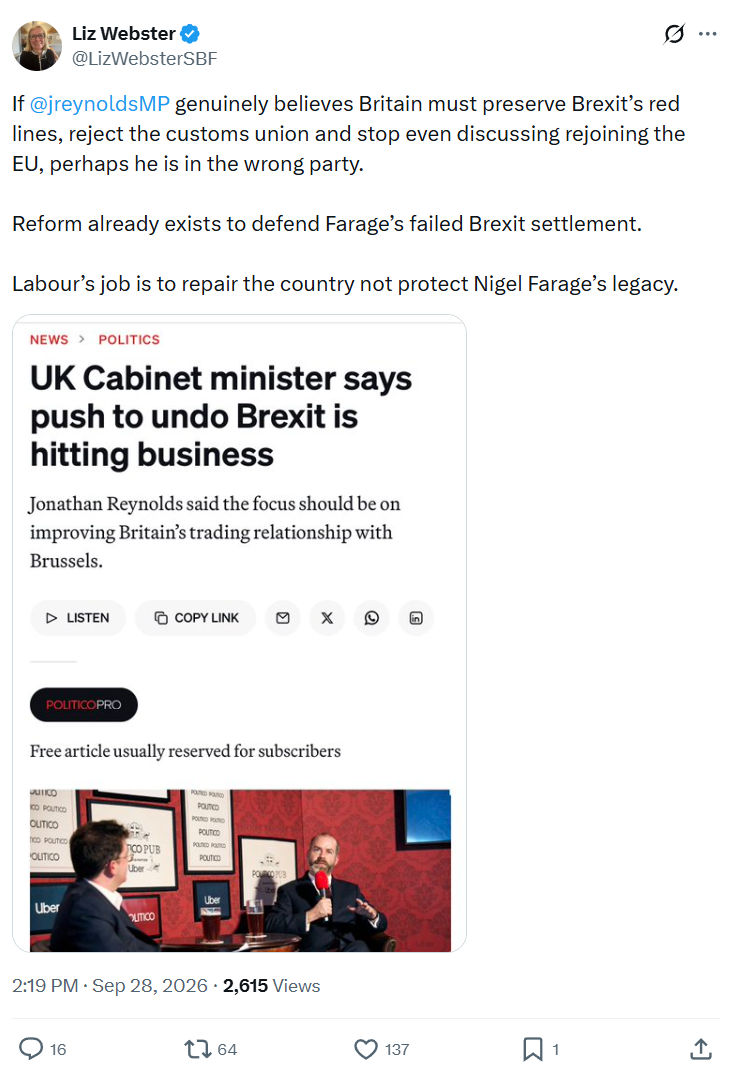
If @jreynoldsMP genuinely believes Britain must preserve Brexit’s red lines, reject the customs union and stop even discussing rejoining the EU, perhaps he is in the wrong party. Reform already exists to defend Farage’s failed Brexit settlement. Labour’s job is to repair the country not protect Nigel Farage’s legacy.
Liz Webster: If @jreynoldsMP genuinely believes...
https://x.com/LizWebsterSBF/status/2104531522426409347

Liz Webster: An influential pro-EU Labour...

An influential pro-EU Labour figure is growing infuriated by @andyburnham not making the case for Rejoin. “Andy’s let the horse out of the stable. He needs to put a f***ing saddle on it.” “You’re not going to see a rally in Hyde Park chanting, ‘What do we want? More options! When do we want them? Some time around Christmas!” The Sunday Times spells out the danger: the Brexit campaigns are gearing up while Burnham retreats into “brainstorming” and leaves the field open to them. The Tories and Reform aren’t just defending the status quo. They’re campaigning for more Brexit. That makes this debate unavoidable. If they want to take Britain further down that road, voters deserve a clear choice including the option to rejoin.

Liz Webster: Brexiters are trying to make...

🚨 Brexiters are trying to make the political cost of discussing Europe so high that Burnham backs away. Their campaign is focused on fear: migration, money and “doing it all again” rather than making a positive case for what Brexit has delivered. There are useful practical steps, including a customs union. But if Britain is to return to the single market’s rules and institutions, we must face the real choice openly: stay out, or seek full membership with a voice at the table. Let voters weigh the options and trade-offs in a proper democratic process. Half measures should not be used to shut down that debate.

Liz Webster: This is what Brexit’s Global Britain looks...

🚜 🐄 🌾 This is what Brexit’s Global Britain looks like from a 🇬🇧 farmer’s perspective. UK food and drink exports have fallen sharply, while trade deals open our market to subsidised imports and future competition from Australian and New Zealand meat and dairy. The costs land on farmers and food producers. Cheap imports may hold down supermarket prices for now, but if British producers are driven out of production, we become more dependent on food from overseas and more vulnerable when supply is disrupted. Every country supports its food producers. Brexit removed British farmers from the EU’s support system, and Westminster failed to replace it with stable, equivalent backing. Food security means valuing the people who produce our food. Farmers cannot keep absorbing the cost of trade deals designed around everyone but them.

Liz Webster: For ordinary people in Britain...

For ordinary people in Britain, the Iran war means a renewed cost-of-living crisis and everyday life becoming increasingly unaffordable. Higher oil and gas prices feed directly into transport, heating, electricity, fertiliser and food. The consequences eventually reach every household, business and farm. Trump doubling down and attempting to “defeat” Iran, a goal even Farage has questioned as achievable, is merely prolonging and intensifying an extremely volatile situation. There is no credible objective, no workable exit strategy and no consideration for the millions of ordinary people around the world being forced to pay for it. This is reckless escalation with British families picking up the bill.

Liz Webster: This is getting stranger...

This is getting stranger. Raheem Kassam calls Kemi Badenoch a “Nigerian scammer”. Jenrick won’t condemn it. Kruger won’t condemn it. Now Farage can’t give Sally Nugent a straight answer about it either. Kassam says he has no official Reform role but also says he regularly visits Reform HQ. So the obvious question is: Why is Reform finding it so difficult simply to distance itself from him and his comments?

Liz Webster: You’re looking in the wrong direction...

You’re looking in the wrong direction. The exploitation is not “migrants versus British people”. Migrants, British workers, farmers and consumers are all caught in the same system. Farmers are squeezed by processors and supermarkets. Workers are squeezed on wages. Consumers are squeezed on prices. Migrants are often used as cheap labour. Meanwhile more and more control over food production, processing, distribution and retail sits with a relatively small number of very large corporations. We all have to eat. That gives whoever controls the food system enormous power. So turning British people against migrants simply divides the people with the least power while leaving the structure above them untouched. That is the danger I’m talking аbout: an increasingly feudal economic model in which ordinary people produce, work and consume, while ownership and control become ever more concentrated. The argument isn’t British versus migrant. It is people versus concentrated corporate power.

Liz Webster: And that’s exactly why I find...

And that’s exactly why I find this “both sides lied” line frustrating coming from a farmer. You know first-hand what has happened to support, labour, export friction, input costs and competition from imports. You can absolutely stand by why you voted Leave in 2016. But that is a different question from whether Brexit has worked for farming in 2026. Farmers are entitled to judge the policy by the outcome, not by the intention. If Brexit has made our businesses less competitive, our market access worse and our food system more exposed, saying “both sides lied” doesn’t make those consequences disappear.

Liz Webster: The real danger is not...

The real danger is not the euro or Schengen. It is that, unless Britain rebuilds its place in Europe, the United Kingdom will break apart. Brexit has already placed a trade border inside our own country, strengthened Scottish and Welsh independence and accelerated the debate over Irish reunification. The resulting arguments over borders, currencies, debt, pensions, defence and trade would create decades of instability. Brexiters warn us about the imagined disruption of rejoining while ignoring the constitutional chaos their own project is already unleashing.e imagined disruption of rejoining while ignoring the constitutional chaos their own project is already unleashing.

Liz Webster: Now it is being said out loud...

🚨 Now it is being said out loud: call a snap election and make it a “reverse 2019”. Former Foreign Office adviser @b_judah says @andyburnham should seek a mandate with rejoining the EU as Britain’s ultimate objective, using the single market and customs union as the first stage. His warning is brutal: Burnham’s popularity may be peaking. A punishing Budget, difficult winter and worsening global instability lie ahead. Delay Europe until his authority has drained away and he repeats Starmer’s fatal mistake. Boris Johnson won an 80-seat majority promising to “Get Brexit Done”. Burnham could unite Britain’s pro-European majority by promising to repair the damage and take us home. Despite today’s denials, the case for an early Brexit election is now being made openly. Game on.

Liz Webster: Empty supermarket shelves...

🚨 Empty supermarket shelves are inevitable and that’s why govt has told people to stockpile. And Brexit is to blame. Britain’s food and drink trade deficit has soared beyond £21 BILLION 🔥 the largest since 2000. Food and drink export volumes fell 11.7% in the first half of this year, while imports remained close to record levels. And this year British farmers have endured flooding, drought, falling yields and soaring fertiliser, fuel and other input costs. We are competing against growing volumes of imported food while fighting one another for a finite SFI budget that’s hotter than Glastonbury tickets. This is how you hollow out domestic productive capacity. You don’t wake up one morning and discover Britain has lost its ability to feed itself. It happens gradually: farms become unviable, processors close, imports rise and domestic production falls. And for years the answer has been: don’t worry, we can import it. Import what? From whom? At what price? In a world of war, climate shocks and increasingly protectionist trade, deliberately becoming more dependent on other countries for food isn’t resilience. Government says food security is national security @andyburnham @angelaeagle Then start treating the businesses producing our food as part of Britain’s critical national infrastructure!

Liz Webster: And there it is...

‼️ And there it is. Grifting the night away begins. Tommy Robinson acknowledges just how serious Danny Tommo’s legal position could be: one of the offences being investigated carries a maximum sentence of life imprisonment. But notice the immediate reframing. 👉Damaging a vessel with an emergency responder aboard becomes “activism”. 👉A police investigation becomes an attempt to “stop Danny”. 👉And before he’s even been charged, the institutions enforcing the law become “parasites”. This is precisely why private political groups cannot appoint themselves to enforce immigration law in the English Channel. 👏 Activism doesn’t put you above the law.

Liz Webster: Burnham tried to appease Brexit...

🚨 Burnham tried to appease Brexit and Brexit punished him for it. The Times reveals an extraordinary sequence of events. The EU had reportedly been prepared to exempt Britain from its “Made in Europe” rules, protecting our deeply integrated car industry and supply chains. But @andyburnham worried that Starmer’s reciprocal youth-mobility agreement would not pass the “Makerfield test” in his Leave voting constituency and sought to reopen it. Brussels responded by withdrawing the British exemption. So an attempt to appease Red Wall Brexit sentiment made the reset deteriorate, delayed the UK–EU summit and left British manufacturing facing an even greater threat. Now Burnham is refusing to rule out putting EU membership in Labour’s next manifesto. By trying to move one step away from Europe, he may have forced himself to move two steps closer. There is a powerful political journey here, if Burnham tells it honestly: Britain cannot demand European privileges while refusing reciprocity. We cannot protect British jobs through permanent Brexit red lines. And governing by the fears of one Leave-voting constituency cannot take precedence over the national interest. The “Makerfield test” has collided with economic reality. Reality won 🏆

Liz Webster: The far right claiming that...

The far right claiming that “the whole of Europe is moving right” is not quite the scare tactic they think it is. If true, it demolishes their own case that the EU is some alien left-wing superstate from which Britain must remain isolated. And when Sweden votes left, they claim the votes of Swedish citizens with immigrant backgrounds somehow count less. Every citizen’s vote carries equal weight. That is democracy. Discounting people’s votes because of their ancestry is ethnic nationalism.

Liz Webster: Jim Ratcliffe...

‼️ Jim Ratcliffe: 🔹 Backed Brexit 🔹 Moved his tax residence to Monaco 🔹 Abandoned plans to build the British Grenadier in Wales and moved production to France 🔹 Now lectures Britain from Denmark about why the country is on the slide And who does he blame? Immigrants and people on benefits. The billionaires who helped hollow Britain out always point down, never at Brexit, tax flight, chronic underinvestment or their own decisions. *Toughness* seems to mean somebody poorer paying the price.

Liz Webster: Steady on...

🚨 Steady on. Reform cannot simply announce that it is taking the Government to the Supreme Court‼️ First it needs a legally arguable claim and permission for judicial review. It would then need to progress through the courts and obtain permission to appeal. The Supreme Court only considers arguable points of law of general public importance. And if Parliament passes clear primary legislation, the courts generally cannot strike it down. There is no guarantee of a judicial review, let alone a Supreme Court showdown. This is political theatre, not legal analysis.

Liz Webster: Dan Hodges says “I do think...

🚨 Dan Hodges says “I do think we are coming to the end of Nigel Farage’s leadership of Reform.” And Julia HB doesn’t even push back. He thinks sleaze is now becoming associated with Reform in the public mind and the scandals are cutting through. This is correct. One controversy can be dismissed as a hit job. Two can be blamed on the establishment. But eventually separate stories begin to form a pattern in voters’ minds.

Liz Webster: Well, this escalated quickly...

🚨 Well, this escalated quickly. On Sunday Nigel Farage told Laura Kuenssberg: “We live in a complainant society.” He claimed the repeated scrutiny of Reform’s finances was a deliberate attempt to “sully the name of the party”. Three days later, the Metropolitan Police have announced an investigation into allegations that donations to Reform UK may have broken electoral law. Reform denies the allegations and an investigation is not a finding of guilt. But this is precisely why political parties are scrutinised. Democracy requires elections AND accountability. Being asked where the money came from and whether electoral law was followed isn’t persecution. It’s democracy doing its job 👏

Liz Webster: This is how political violence becomes...

‼️🚨 This is how political violence becomes normalised. Climate activists interrupted Nigel Farage’s Reform conference speech to question him about an alleged £5 million gift from crypto-billionaire Christopher Harborne. Members of the crowd dragged, punched and kicked them. One activist was struck with a crutch; another had her hair pulled out. 🔥 How did Reform’s leading figures respond? Lee Anderson joked about holding a whip-round to replace the attacker’s walking stick. Robert Jenrick said protesters “take their chances”. Farage dismissed criticism of the violence as “utter nonsense”. First, opponents are branded “far-left” enemies, then attacking them is excused. Next, it becomes something politicians joke about. Eventually, intimidation becomes part of the movement’s culture. Most revealingly, the crowd used violence to shield a powerful politician from questions about billionaire money. The violence was not separate from the issue, it demonstrated it: concentrated wealth, political power and mob intimidation combining to silence democratic scrutiny. This is authoritarianism learning to walk.

Liz Webster: This is a disgracefully evasive...

‼️ This is a disgracefully evasive and weak answer from @andyburnham @amcarmichaelMP asked whether Britain would protect consumers and farmers from Brazilian beef the EU is banning over inadequate antimicrobial assurances. Burnham deflected to public procurement. Schools buying British beef will not stop rejected Brazilian meat entering supermarkets, restaurants and processed foods. This is a public-health and food-standards issue not a procurement exercise. Britain must mirror the EU suspension immediately. We cannot become the dumping ground for meat our nearest market refuses to accept. Two people are dead and 474 have contracted Salmonella in outbreaks strongly associated with imported eggs served in cafés, restaurants and takeaways. Public procurement does not protect anyone eating outside a school or hospital. It neither stops rejected imports entering Britain nor provides traceability once they disappear into catering and processed food. Food safety requires prevention, not excuses after people become ill.

Liz Webster: This interview tells me that...

This interview tells me that: Brexit failed comprehensively. The Conservatives must become pro-European again, but Britain must reach that conclusion without requiring Brexit’s architects to admit what they did. That is Seldon’s reconciliation project. He seems to understand where Britain must go, but possibly fears that telling the full truth about how it got here will make the journey impossible. But the risk is that appeasement preserves the original myths, allowing the manipulation to continue. Voldemort survives.

Liz Webster: A private project underwritten...

A private project underwritten by up to £71 million of public money, while the taxpayer receives only a minority stake and rights to part of the concentrate, not control of the company or the value chain. Britain still lacks the refinery needed to turn that concentrate into usable tungsten. Public money absorbs the risk; private shareholders retain control and capture the gains. That is not industrial sovereignty @andyburnham 👉 it is corporate welfare dressed up as national security.
Read more