



Color Scheme

Daniel Lacalle: The UK economy has been demolished…

The UK economy has been demolished by net zero, uncontrolled immigration and keeping/increasing all EU taxes and overregulations. Nationalising British Steel will burden taxpayers and wil not make it competitive when energy costs have soared due to net zero.
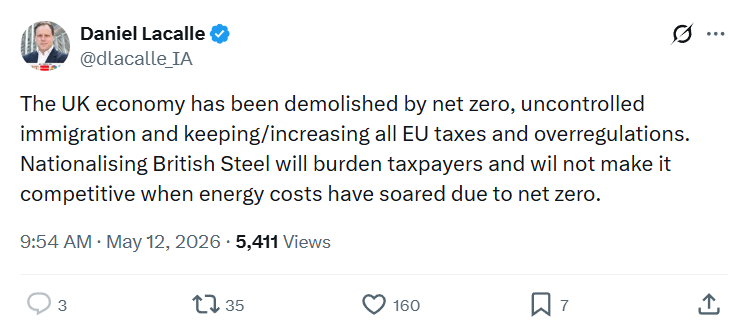
Daniel Lacalle: The UK economy has been demolished…
https://x.com/dlacalle_IA/status/2054092790733148359?s=20

Daniel Lacalle: The US does not need to bow…

The US does not need to bow to Iran’s threats. Every day, the “Hormuz weapon” loses power as American oil production, exports, and alternative routes make the global energy system more resilient. Tehran can rattle the chokepoint, but it can no longer hold the world economy hostage. When a supplier or infrastructure owner stops understanding its position and starts using its initial advantage to damage and blackmail its customers, it is really signing its own death warrant. What looked like dominance becomes a countdown to irrelevance. Graphs via Bloomberg and BNE Intellinews.

Daniel Lacalle: Not only is the Iran war causing a decline…

"Not only is the Iran war causing a decline in global output, but the world’s central banks continue to embrace easy-money policies. This will result in more dollars (or sterling, euros, or yen, etc.) chasing fewer goods. This will further fuel rising prices. This is why we continue to see a general rise in prices. If rising prices were merely a result of falling output in Persian Gulf related goods, then we’d see rising prices in some areas result in falling prices in other areas. In other words, if the money supply were reasonably stable, consumers would respond to rising prices in some areas by cutting spending in other areas. But the CPI suggests that’s not happening. Thanks to continual infusions of new money through loose monetary policy, consumers are able to continue bidding up prices in all areas, even as price increases in the energy sector rise to multi-year highs". @ryanmcmaken @mises

Daniel Lacalle: Oil spikes and wars grab headlines…

Oil spikes and wars grab headlines, but they do NOT create persistent inflation. ❌ Blaming “oil” or “wars” for persistent inflation is comforting—and wrong. They move relative prices for a while, but they do not make the aggregate price level rise year after year. ❌ Oil shocks reshuffle prices: energy up, something else down. Unless central banks and governments validate the shock with massive spending and easy money, the overall inflation rate falls back. A one‑off oil spike cannot explain years of rising aggregate prices. If oil prices or “supply chains” caused inflation, we would have had deflation between 2022 and 2025. Instead, aggregate prices kept rising as governments spent and printed at record levels. ❌ Wars are usually disinflationary. They freeze or destroy investment plans, delay big consumption decisions, and raise uncertainty. Households and companies cancel or postpone spending—they don’t go on a buying spree. ✅ What turns temporary shocks into persistent inflation is policy. Massive fiscal deficits, monetized by central banks, keep demand above supply and embed higher prices into the system: more units of currency chasing the same goods and services. ✅ The pattern is clear: every time central banks and governments flood the system with liquidity and deficit spending, core inflation moves up and stays up. When they finally cut spending and tighten policy, inflation rolls over—regardless of oil or war headlines. ✅ Inflation is not a mysterious external monster. It is a political choice: spend, borrow, and print beyond the real capacity of the economy, and the unit of account gets diluted. Stop doing that, and “persistent” inflation disappears. ✅ Wars and oil shocks matter for volatility and individual prices, but the only reason aggregate prices keep marching higher year after year is simple: governments that refuse to adjust spending, and central banks that refuse to say no. Stop asking the government for “free” things. You will pay for them many times over. Graph via FRED

Daniel Lacalle: It makes no sense for central banks...

It makes no sense for central banks to hike rates in a temporary energy shock. Rate hikes hurt consumers and businesses, and have no impact on the geopolitical risk premium attached to commodity prices or on government spending plans. Furthermore, by keeping money supply and liquidity elevated, central banks incentivise and perpetuate high government borrowing, which causes persistent inflation. Hence, hiking rates and incentivising government spending exacerbate the same productive sector weakness and stagflation risk they claim to try to avoid.

Daniel Lacalle: Mamdani declares New York bankrupt…

Mamdani declares New York bankrupt and asks for a bailout. Behold the socialist trick of “tax the rich” in all its glory. Envy and hate: Announce a massive spending plan supposedly financed by squeezing “evil” millionaires and rich citizens. Lie: Blame a fabricated “revenue problem” despite record tax receipts of $162 bn in 2025 and more than $55 bn of extra revenue since 2010. Deceit: Use the narrative to justify massive tax hikes on everyone, especially the middle class and the very voters who applauded the slogan. The “tax the rich” promise always turns into an “impoverish all” reality. This is the true “warmth of collectivism." Enjoy the vote. #Mamdani #newyork

Daniel Lacalle: Gasoline prices reach $7.15 per gallon…

Gasoline prices reach $7.15 per gallon on average in the European Union. Gasoline is 68% more expensive than in the US. Diesel is 59% more expensive. The average salary in the US is 35-40% higher than in the EU. No EU country has cheaper gasoline prices than the most expensive US state (California) For years, progressives in the US have demanded the same taxes for gasoline as in Europe. Imagine if it had happened.

Daniel Lacalle: Things are very different today…

Things are very different today from 2008, 2018, or even 2022. US dollar strength is mitigating inflationary pressures in the United States. The strong correlation between oil prices and the US dollar limits the impact of geopolitical risks. The US is now a net exporter of oil and natural gas, making America a shock absorber, not a shock amplifier. Import prices in dollars are significantly better than in other developed economies. Graphs via Bloomberg